

The combination of private cloud and open-source technologies caught my attention in the OSMC 2024 program, as I’ve recently been deeply engaged in working with a monitoring solution. After completing my Icinga Fundamentals Training and a hands-on project where I set up Icinga monitoring for my Nextcloud server, I was eager to dive deeper into the topic. However, I wasn’t sure what exactly was meant by “private cloud” in this context, so this talk provided valuable new insights for me.
Introducing the Speaker and the Topic
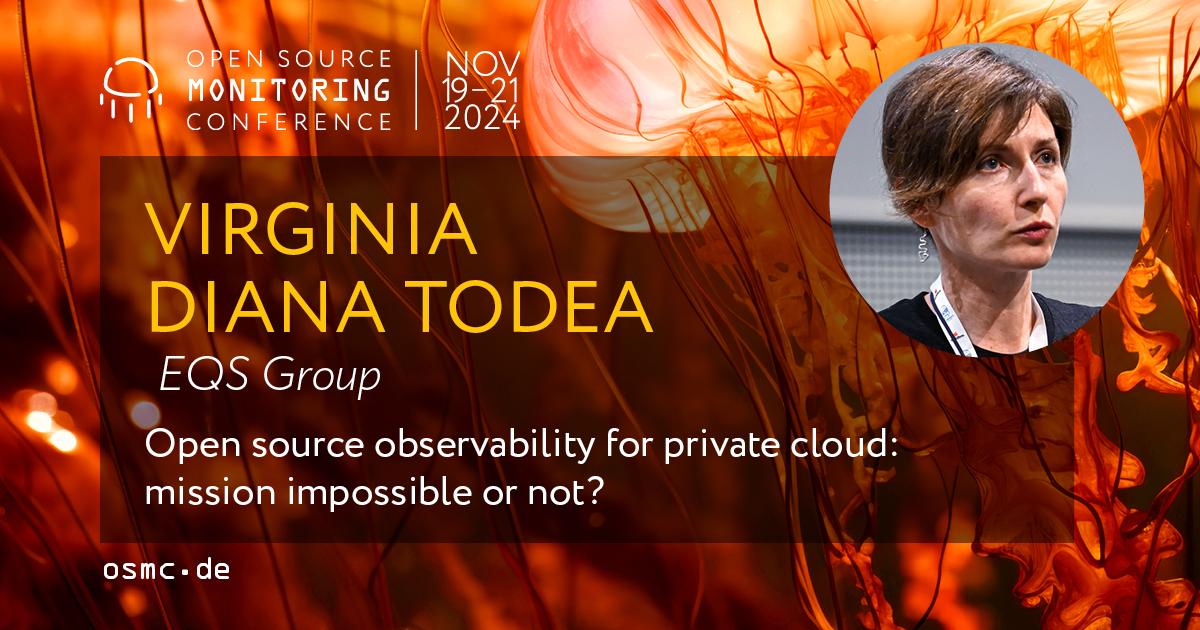
At OSMC 2024, Diana Todea, a Senior Site Reliability Engineer (SRE) at EQS Group, presented her talk, which focused on the technical and practical challenges of implementing open-source observability in private cloud environments
What Is a Private Cloud?
Her presentation wasn’t about a single application like Nextcloud but about private cloud in a broader sense—a custom-built, comprehensive infrastructure that integrates various services, data, and applications while meeting strict privacy and security requirements (such as EU regulations). The challenge lies in connecting and utilizing numerous open-source projects, such as OpenTelemetry, Jaeger, and Grafana, within a scalable environment. Achieving this requires not only technical expertise, but also close collaboration between developers and SREs.
“What private cloud taught us?”
Diana asked this question and provided clear answers based on her practical experience. She emphasized the importance of carefully considering priorities, costs, and security aspects when planning a private cloud. One key point she highlighted was that a private cloud should not only be modern and secure but also usable and relevant for developers. Her motto “Less is more” underlined the idea that it’s often better to keep cloud infrastructure lean and manageable rather than chasing the latest trends.
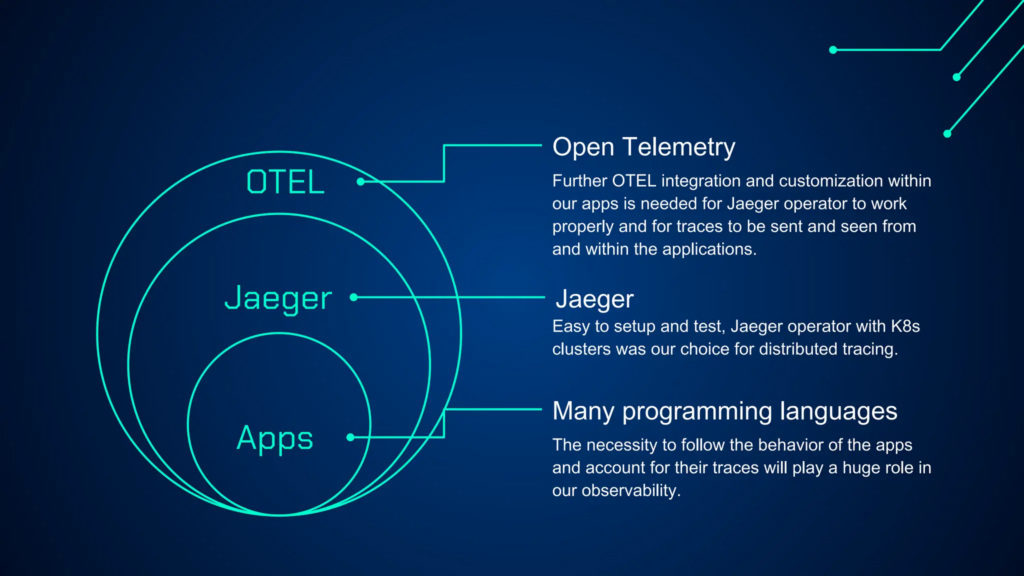
Diana also shed light on the tough challenges her team faced. A major question was whether existing Application Performance Monitoring (APM) solutions could be replaced with open-source alternatives and whether the ELK Stack (Elasticsearch, Logstash, Kibana) was a viable option. She stressed that the tools used should truly benefit developers, such as through synthetic monitoring (simulated user actions to test availability and performance) in Grafana or distributed tracing (tracking data flows across multiple services) with open-source tools like Jaeger.
Diana shared some of the hurdles she encountered in her daily work. For example, although OpenTelemetry is considered a standard for observability, she criticized its insufficient documentation and integration issues. On the other hand, she had positive experiences with Jaeger, which integrates well with Kubernetes.
Personal Takeaways as a Trainee
What I found particularly interesting was how openly and honestly she discussed these technical challenges. As someone who is just beginning to explore the world of monitoring and observability, it was motivating to learn that even experienced IT professionals like Diana face obstacles and have to work hard to find solutions.
The Bigger Picture: Collaboration and Inspiration
Overall, I was deeply inspired by the idea that open-source software not only provides solutions but also fosters knowledge-sharing and collaboration. Diana Todea impressively demonstrated the importance of facing challenges as a team and coming up with creative solutions together. Sometimes, it takes a shared vision, determination, and perseverance to turn the impossible into ‚Mission Possible‘
OSMC 2025 – Stay Tuned
Save the date for the next OSMC taking place from November 18 – 20, 2025 in Nuremberg, Germany. We can’t wait to welcome you to the 19th edition of the Open Source Monitoring Conference!
0 Kommentare